NEWS
More heat than light in the affair of the Gemini V gold stater
Louis "The Coin" Colavecchio's counterfeiting equipment is auctioned off
More on Chinese counterfeit coins and slabs
The British authorities struggle to withdraw counterfeit one-pound coins
COUNTERFEITING SNIPPETS FROM AROUND THE WORLD
ON-LINE RESOURCES
IN PRINT
"Examination of some counterfeit Indian 5-rupee denomination coins: a case study."
"Counterfeit coins of England and the United Kingdom"
"A Lead Impression of a French Coin from Somerset"
Other recent literature viewed
Welcome
Apologies for the late appearance of this edition. This was due to a combination of the editor being rather busy and the need to wait for information to complete a couple of the articles. Time pressure has also meant less of the short news items usually included.
High quality collector coins
When dealing with the possibility of a high quality counterfeit coin one hundred percent certainty is a rare if not impossible verdict. One has to weigh-up possibilities and probabilities. Understandably the coin trade finds it difficult to deal with these nuisances. They do not want uncertainty. This can be corrosive to the integrity of the authentication process. The editor wonders is he being naive by asking for a more mature attitude by auctioneers and dealers? Is it too much to ask for the catalogue descriptions of sale items to reflect some of this uncertainty? I am sure that this would only improve their reputation and in the long run the business of these companies.
British one-pound coin counterfeits
The editor sent emails to the British Treasury, the Bank of England and APACS requesting to know who was responsible for the regulation of the coin-handling, British cash centres. The Treasury choose to ignore the question. The Bank of England acknowledge the email but said they did not know when they could give a considered reply. APACS firmly stated to the editor that: "APACS does not have an oversight role as regards coin processing or coin processing equipment." The conclusion must be that "nobody has been home" looking at how the banks and cash centres perform their operations. It is seven years since the first Royal Mint survey showed a cause for concern with almost one percent of circulating one-pound coins being found to be counterfeit. In this time the number of counterfeit one-pound coins has risen to over two and a half percent. Yet there has been no significant increase in the number of counterfeit coins being withdrawn by the banks and cash centres [see story below]. It has taken the British authorities all this time to start to wake-up to the problem.
The editor cannot stop from popping into his mind an imaginary scene between a cash centre manager and his/her boss.
Cash centre manager, "We need to invest x pounds in new coin counting and authentication machines to identify the large number of counterfeit one-pound coins in circulation."
Bank boss, " What rate of return do you expect on this investment?"
Manager, "None, we will have to write-off all the counterfeit coins we find, so we will make a large loss on the investment".
Bank boss, "Investment refused."
Given the behaviour of some in the banking and financial world during this current crisis does this scene seem so implausible?
Behind this bamboo curtain is a photograph of the counterfeit featured in the Bulletin of Counterfeits 1996, Vol 21, No 1, page 8, authors: SH/AW. The editor is sure the IAPN will find the time to reply to his request for permission to reproduce the image, sometime. For those unable to wait to see the counterfeit visit this ForgeryNetwork entry.

This space was reserved for a photograph of the gold stater, lot 604 featured in the the Gemini V auction. Unfortunately Harlan J. Berk have refused permission to reproduce a photograph of the coin. For those wanting see the coin visit this ForgeryNetwork entry.
More heat than light in the affair of the Gemini V gold stater
In the Bulletin of Counterfeits of 19961 Silvia Hurter and Alan Walker reported on a counterfeit of a gold stater from the Greek city of Pergamum in the province of Mysia [today part of modern Turkey]. Silvia Hurter was the then editor of the "Bulletin on Counterfeits". At this time both she and Alan Walker worked for Bank Leu Numismatik in Zurich. They were and are vastly experienced numismatists who have authored a long list of papers and books on ancient coins. They reported that there were only four or five specimens known of this very rare stater that dates from the early part of the fourth century BC. They stated that the one in at the "Staatliche Museum zu Berlin", clearly served as a model for the counterfeit. Their verdict said:
"The obverse is fairly close to the model although it is by no means a galvo-type copy. The reverse of the counterfeit is more fanciful; the head of Athena is far too large in proportion to the body. A crested helmet is the usual symbol found for this issue, though here the crest does not follow the shape of the helmet. A second symbol can occur, but the strange bird (a dove or a chicken) does not make sense."
"The general aspect of the coin is of a dazzling freshness, as if made yesterday".
There this matter seemed to rest until the catalogue for the Gemini V auction was published. The Gemini auctions are jointly undertaken by two prestigious USA ancient coin dealers, Harlan J. Berk of Chicago and Freeman and Sear of Los Angeles. Both these dealers are members of the "International Association of Professional Numismatists, IAPN" who through their anti-forgery committee published the "Bulletin on Counterfeits". The auction took place at the Waldoff Astoria Hotel, Park Avenue on the sixth of January 2009 during the New York International Numismatic Convention. One of the stars of the catalogue was lot 604, a gold stater of Mysia, Pergamum with an estimate price of $140,000. No provenance was listed for the coin and the literature references were acknowledged not to refer to the reverse of this coin. The coin was summarised as:
This coin is distinguished by its rooster symbol, which does not appear on any other recorded stater of Pergamum. The reverse style and, to a lesser degree, the obverse style also differ from those of the known staters.
One man's rooster is another man's dove or chicken.
It would appear the auctioneers did not spot the coin's strong similarity to the counterfeit described in the "Bulletin on Counterfeits". This similarity was noted on a number of ancient/counterfeit coin discussion sites. The Harlan J. Berk Company stated to the editor2:
"We are and were aware of this about two weeks before the sale."
The initial reaction appeared to be to withdraw the coin. Thus on-line on the fifteenth of December 2008 the lot was listed as "(With Drawn)". The Harlan J. Berk Company continued: "At the show, we had a number of fellow IAPN members look at the coin. Most, about eighty percent thought it was genuine but not everybody. We had a bid from an informed collector who knew the whole story and feels the coin is genuine. He bought it in the sale". On the fifteenth of January 2009 on the Gemini website the lot was listed as sold for $100,000. No additional reference was added to the coin description concerning the "Bulletin on Counterfeits" article.
Comment
The editor is slightly confused as to whether the Gemini auctioneers are stating that the coin is genuine or are stating there may be some doubt about the coin but the buyer is aware of the risk. Whatever their motives by their actions the auctioneers have put their prestige behind this coin. This coin's provenance will now carry this auction record with no doubt about the coin's authenticity recorded.
References
Note 1: "Bulletin on Counterfeits", 1996, Vol 21, No 1, page 8, authors: SH/AW.
Note 2: email to editor from an unnamed person at
[Other sources: Gemini V website; Yahoo groups: Moneta-L, CFDL; ForgeryNetwork; Wikipedia]
Return to Contents.
Shortly after the article above was completed, the "Cultural Property Observer", recorded the death of Silvia Hurter. She was based in Switzerland but it seems she died in January 2009 after an accident while on a trip to New York. It is believed she was about 75 years old.
The editor never met Frau Hurter but admired her work against counterfeiting for many years. She took over as chair of the IAPN's Anti-Forgery Committee from Patrick Finn in 1979. By this time she had already worked for Bank Leu in Switzerland for twenty-five years. Peter Seaby wrote at the time, "..she is widely recognised as one of the leading authorities in ancient numismatics." Although she had contributed an occasional piece to the Bulletin of Counterfeits it is from this time that her influence could be seen in changing this publications coverage much more towards the coins of the ancient world. In 1984 she became joint editor of the BoC and it was not long before she became sole editor. She continued as editor until it ceased publication just prior to the start of this century.
The importance of the Bulletin of Counterfeits in the fight against counterfeiting can not be overstated. Silvia Hurter stands along side Peter Seaby, a former IAPN president who pushed for its founding and E.G.V.Newman, the founding editor, as the major forces in shaping the BoC. Those who in a small way attempt to follow Frau Hurter's lead are grateful for her work.
Return to Contents.
Louis "The Coin" Colavecchio's counterfeiting equipment is auctioned off
In September 2008 Rhode Island State Police put up for auction a number of pieces of equipment seized when they arrested Louis Colavecchio for counterfeiting casino tokens. The photographs of this equipment have been reproduce here to demonstrate the sophistication of many modern counterfeiting operations [see the previous story on Colavecchio in Newsletter 7]. The Cool Justice Report describes how Colavecchio is becoming a minor, celebrity speaker and achieving praise for a novel "in progress".
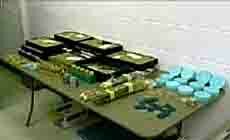
Some of the equipment display by police when Colavecchio was arrested. It possible to see; scissel [strip after coinage blanks have been punched out], dies and rubber impressions of tokens. |
![An EDM [Electrical Discharge Machining] Machine](images/casino4.jpg)
An Electrical Discharge Machining, EDM, Machine presumably used to reproduced the token dies. This type of equipment is also known as a spark erosion machine. |
||
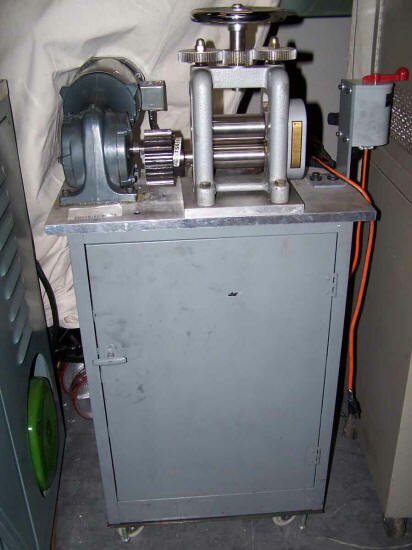
Rolls used to produce strip of the required thickness. |
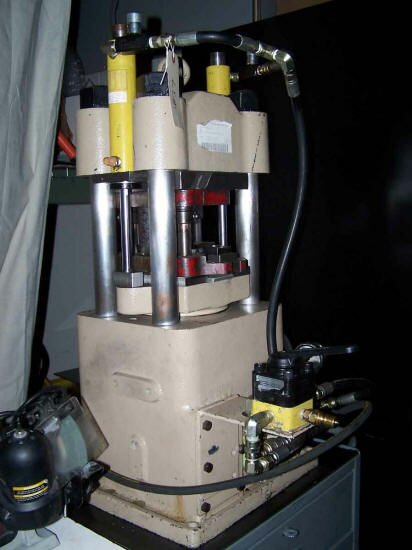
A press used to either produce coinage blanks or to strike the tokens. |
||
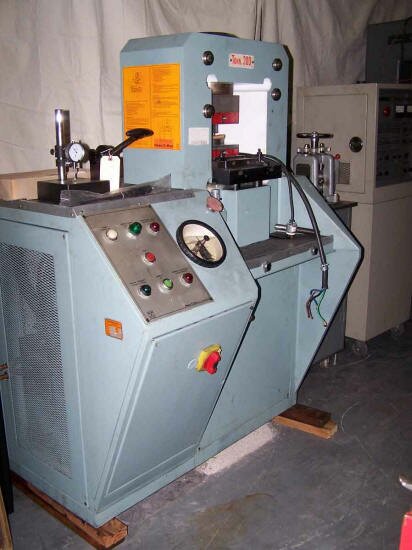
A press believed to have been used to strike the tokens |

Electro-plating equipment, the purpose of this equiment is not clear. |
[Sources: S.J.Corio Company, The Cool Justice Report]
Return to Contents.

Photograph of a replica 1914 USA one cent on sale from China on an internet auction site
More on Chinese counterfeit coins and slabs
Part I: Jinghuashei
Susan Headley, of About.com, has expanded her blogs on Chinese counterfeiting into three articles for "Coin World". Although such "Coin World" articles are usually only available on-line to subscribers, they have judged the importance of this subject sufficient to make them freely available. Two of these articles can be found at:
Part 2: Chinese counterfeits: deceptive U.S. errors eyed as growth area
If the reader has a problem with any of the above links go to the Coin World website and search for Chinese counterfeiting.
The most important part of these articles are the communications from the Chinese replica/counterfeit/fake coin manufacturer, Jinghuashei. He uses this name for selling on eBay. The 26-year old Jinghuashei owns the "Big Tree Coin Factory". He claims to be the largest Chinese manufacturer of his type. He is situated in Fujian province and claims to have up to one hundred competitors. He claims he produces about 100,000 fake Chinese coins per month. These are mainly sold into China as tourist souvenirs. He sells about one thousand USA fakes per month via eBay and also several thousand fake world coin types per month.
Jinghuashei claims that by only producing copies of coins dated prior to 1949 he is operating perfectly legally in China. He also claims to only sell his copies of USA coins with a "REPLICA" stamp and believes this to be legal in the USA. The USA's Hobby Protection Act requires the use of the word, "COPY".
The articles indicate that Jinghuashei's operation is mainly involved with impressing the designs onto the replicas. The dies are made in another specialist workshop. These are produced by laser scanning a three dimensional image into a digital coin sculpting system. This digital image is "cleaned up" to remove die faults marks etc. The image is then laser cut into a steel die. No mention is made of die polishing but it is believed that laser cutting would require this. The coin blanks are obtained from another outside manufacturer. Those for the Chinese coins are made of "iron" [does this mean steel?] and those for USA coins a copper nickel alloy. Although it is not reported, it must be assumed both of these alloys are often coated.
Coin World purchased twelve of Jinghuashei's coins and at their request he left off the "REPLICA" stamp. They judged all twelve were "very good counterfeits" with a 1909-S Lincoln, V.D.B. cent being the most deceptive. The just-struck appearance of the copies was considered their main weakness. The article quotes the weight, relative density and physical dimensions found on these copies. These results showed good indications that the pieces were not genuine. The impression given is that Jinghuashei has not been producing the higher grade Chinese counterfeits that are made of the correct alloy.
The editor took a one-day dip into the listings of USA coins worldwide on eBay in late December, about 120,000 items were listed. There were many replica coins being offered from China and Hong Kong but none from Jinghuashei. Perhaps Jinghuashei has decided to change his listing name after all this publicity. All the Chinese offerings noticed were for replica coin. According to eBay's rules these should have been in a separate category and not with genuine coins.
Part II: Counterfeit Slabs
As recounted in previous newsletters counterfeits of both NGC and PCGS slabs have been found originating from China. NGC, on their website, have described how to identify the counterfeits of their slabs. PCGS have not done this. In the third of her "Coin World" articles Susan Headley has attempted to rectify this by describing the differences on the PCGS counterfeit slab. A number of these have been identified by an unnamed Chinese counterfeiter.
Diagnostics help to identify fake PCGS slabs from China Counterfeiter details key differences
The two grading companies appear to be following very different strategies to combat this problem. As previously described NGC initially described the differences between their genuine slabs and the counterfeits. Since this they have introduced a new design of slab that they claim is more difficult to copy. Finally they have announced a coin photography initiative. They are to photograph every coin they certify. These photographs will be stored in an internet accessible database. This will allow coin buyers to compare the genuine slabbed coin with those offered for sale. Obviously these last two initiatives will not help with those coins already slabbed. PCGS's strategy to combat this problem has been a lot more confused. They have advised collectors not to buy from Chinese eBay sellers. They also purchased a number of used counterfeit Chinese coin dies from a counterfeiter. These dies were higher publicised by PCGS and displayed at the Long Beach Expo presumably to make customers aware of the problem. Finally they participated in the Beijing International Stamp and Coin Exposition. Here they showed newly introduced slab labels written in Chinese. PCGS have undertaken two conflicting strategies, warning customers to boycott China but themselves trying to generate business in the area.
[Sources: Susan Headley of About.com, Coin World, eBay, NGC, PCGS, CoinNews.net]
Return to Contents.


Photographs of the latest addition to the editor's reference collection of one-pound counterfeit coins. P45 nominally dated 2004. Click on the photograph to see a larger image.
The British authorities struggle to withdraw counterfeit one-pound coins
[See also "My Coin Diary" for September]
There was a flurry of reports on one-pound coin counterfeits in the British press in September 2008. These followed the reporting by the BBC of a Royal Mint survey finding that two percent of the one-pound coins in circulation were counterfeit. Subsequently Conservative MP, Christopher Chope, asked the Chancellor of the Exchequer a number of questions about the issue. Treasury Minister, Angela Eagle, replied giving the number of counterfeit one-pound coins returned to the Royal Mint over the last five financial years [note: previously these figures have been reported on a calendar year basis].
| Financial Year | Number of counterfeits withdrawn |
| 2003-2004 | 85,500 |
| 2004-2005 | 117,500 |
| 2005-2006 | 84,500 |
| 2006-2007 | 153,800 |
| 2007-2008 | 97,000 |
Based on the Royal Mint survey results it can be calculated that between two to three million counterfeit one-pound coins are entering circulation every year. Based on these results the inadequacy of this withdrawal rate becomes obvious. The Royal Mint informed the editor that in the nine months up to and including December 2008 a provisional figure of 360,000 counterfeits had been returned to the Mint. Providing the Royal Mint's inspection confirm these coins as counterfeit this is a very welcome, but still inadequate, increase in the withdrawals of counterfeit one-pound coins .
The reason why the British banks and cash centres are struggling to cope with these counterfeits becomes apparent in the answers by APACS to some queries from the editor. APACS defines itself as:
"APACS is the UK trade association for payments and for those institutions that deliver payment services to customers."
APACS firmly stated to the editor that: "APACS does not have an oversight role as regards coin processing or coin processing equipment." Although one of its objectives is: "3.1.10 To facilitate and promote the development of industry measures to reduce payment-related fraud and criminal activities in payments;". This raises the question who is responsible for the efficiency of the banks and cash centres in weeding out counterfeit coins. APACS says:"There is no UK equivalent to the European Commission's Anti-Fraud Office (OLAF)" and "no list of certified sterling coin authentication machines." APACS continued that, "On to the subject of "standards/good practice guides" we feel that the Royal Mint as the "manufacturer" of the coin is best placed to issue these". To the best of the editors knowledge no such guides exist. The editor has had a problem finding a body that accepts responsibility for the oversight/regulation of the banks/cash centres coin operations. In the last analysis it should be the British Treasury but they are refusing to talk to him.
When asked what percentage of circulating one-pound coins the banks and cash centres authenticated prior to re-issue APACS could not give a definitive answer. They did say that, "The bank and security company cash centres use Scan Coin 4000 machines to count, sort and check for counterfeits. This year, Scan Coin has worked with the Royal Mint to review its settings and has recalibrated all the processors' machines using samples provided by the Mint. This has resulted in a significant increase in the number of counterfeits being identified and returned to the Mint for checking and destruction. It should be noted, however, that the two models of Scan4000 currently in use cannot identify all counterfeits: the newer bi-metallic model can identify up to 40-45% of known counterfeits whilst the older model can only identify 12-20%." Obviously there is a urgent need to at least replace all of the older Scan Coin 400 machines. Also needed is work with companies such as Scan Coin to investigate further improvement to their technology. It would appear that usefulness of automated, visual inspection techniques needs investigation but who will fund such an investigation?
STOP PRESS: in January 2009 "The Independent" newspaper reported the Royal Mint's autumn 2008 survey of one-pound coins had found 2.58% were counterfeit.
[Sources: Hansard, Royal Mint, APACS]
Return to Contents.
COUNTERFEITING SNIPPETS FROM AROUND THE WORLD
Taiwanese counterfeiter made half a million fake NT$50 coins over ten years
In October 2002 the Taiwanese Criminal Investigation Bureau arrested a 61-year-old counterfeiter, named Lin. They stated that Lin admitted making counterfeit coins for over ten years in a "makeshift" factory. The police seized a large number of finished and unfinished fakes. The counterfeits were sold by Lin to accomplices who disposed of them through local markets, convenience stores and automatic vending machines.
The current NT$50 coin was first issued in 2002. It is made of aluminium bronze. The coin is 28 mm in diameter and contains a latent image on the reverse size.
Return to Contents.
The so-called 1853 United States Assay Office proof gold $20
The "Society of Private and Pioneer Numismatists", SPPN, was founded in 1992 and is organised from the Kagin's Inc. offices in Tibaron, California. In August 2008 a press release from Kagin's announced that the SPPN had determined that the so-called United States Assay Office proof gold $20 were "Transfer Die Forgeries". Kagin's Inc. reported that, "The Transfer Die Forgeries first appeared during the late 1950ís, ďdiscoveredĒ by Paul Franklin through a bank teller in Arizona. Franklin and John J. Ford Jr. sold hundreds of these pieces throughout the 1960ís as genuine pieces struck in San Francisco by the U.S. Assay Office in 1853. An arbitration hearing of the Professional Numismatists Guild in the late 1960ís ruled that the pieces were not proof, but could not come to an agreement on the authenticity or vintage."
The report went on to say, "In 2006 Donald Kagin, Ph.D. and David J. McCarthy of Kaginís, Inc. of Tiburon, Calif. were processing images of one of Kaginís clientís collection for the upcoming 2nd edition of Private Gold Coins and Patterns of the United States. McCarthy noticed that the clientís unquestionably authentic 1853 Assay Office $20 bore bag marks in the same location as repeating depressions on the questionable Franklin Hoard coins." Finally the report says, "At the conclusion of the discussion moderator Kagin asked the panel to accurately and succinctly title the coins in question. The experts unanimously agreed these pieces are best described as Transfer Die Forgeries."
Comment
There have been almost no references to John J. Ford Jr.'s dubious history since his death in 2005. John Kleeberg and T.V. Buttrey in the website published much information before his death and this is still the best source of information on Ford. This report is to be welcome in addressing a small section of Ford's operations. It is a pity this report has not seen fit to acknowledge Kleeberg and Buttrey's courageous stand.
Is the editor being too cynical in seeing the insistence of the use of the term "Transfer Die Forgeries" as some form of special pleading? [The editor has subsequently examined much fuller reports on this matter and now feels the sentiments in this sentence were unfounded. It is not our policy to retrospectively change reports so the sentence has been left in this newsletter. See CCN13, December 2009]
[Source: Kagins Inc., HOW THE WEST WAS FAKED]
Ashmore replicas
A correspondent informs the editor that a current eBay seller of Ashmore replicas is claiming to be Trevor Ashmore himself. It unclear whether he is selling new types of replicas or ones previously recorded.
Return to Contents.
July 2008
As usual this month I was busy finishing my July newsletter. I did however have time to read a fine, short novel, "The Dig", by John Preston. It is a fictional treatment of the discovery and excavation of the funeral ship-burial at Sutton Hoo just before the Second World War. Wikipedia describes this as, "one of the most magnificent archaeological finds in England for its size and completeness". The novel describes the events through the eyes of three, well drawn main characters. It features the lady owner of the land who instigated the excavation, the local man who originally undertook the excavation and first found the remains of the ship and the female archaeologist who found the first piece of treasure. Twice in the story coins have a crucial role. The discovery of the first coin in the excavation helped date the ship to the Anglo-Saxon period and the lady archaeologist remembers how her imagination and interest in archaeology was sparked by the childhood gift of a Roman coin. There must be many numismatists whose interest was similarly started as a child or a teenager. This novel has the reek of authenticity, with the slow grind of the dig and the need for teamwork yet with petty ambitions and animosities hindering progress. I highly recommend this book.
August 2008
|
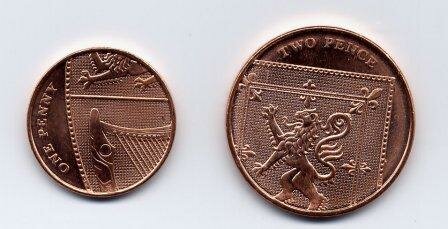
The UK 1 and 2 pence new reverse designs. |
During this month my wife received, in her change, one and two pence coins bearing the new 2008 reverse designs that were introduced in April this year. They are the first of these new coin designs that we had received. These low denomination coins are the most numerous of the UK coins and are often issued throughout the year. The main issuing period for the higher denomination UK coins tends to be towards the end of the year when Christmas spending usually produces a heavy demand for coins. The weight and diameter of these copper-plated* coins remains unchanged at 3.564g/20.32mm and 7.128g/25.91mm respectively. *Since 1998 the Treasury/Royal Mint have retained the option of reverting back to a bronze alloy for these coins if circumstances favour that unlikely option. |
28 August, this entry started as a moan about the lack of up-to-date information on the Royal Mint website. When I e-mailed the Mint an old colleague replied with the pained expression that I was being "a little harsh and inaccurate". It appears the information was there but I was looking in the wrong place. I apologised for my mistake. However I notice that by December, the information on the site has been gradually revised and updated.
|
Ten early twentieth century British "silver" counterfeits. Click to see a larger image. |
||

|
1 September, today I received ten white metal cast counterfeits that I purchased from a British dealer's website. The counterfeits' nominal dates range from 1895 to 1950. Usually a circulation coin counterfeiter will copy a recently issued coin that does not have too much wear. Using this logic I assume these coins were made in the period from about 1897 to 1960. It is valid to ask how I can be sure that these pieces are contemporary counterfeits rather than made at a much later date. The honest answer is it is impossible to be sure. Items such as this do not usually have a documented history or any features unique to the period. The dealer tells me that he accumulated them over a period from various sources. This and the low price I paid are the only indications that I have that they are probably not recent. A short preliminary examination of the counterfeits has revealed a number of interesting features. The weights of the counterfeits are variable and easily identify them as fake. Eight of the ten are tin alloy castings. The other two are probably made from a 60/40 lead/tin alloy. Only one, no. 8, has a significant amount of surface coating. A number of the counterfeits have physical damage consistent with them having been tested by bending, cutting or scrapping at some time in their life to indicate whether they were genuine. |
Ten counterfeit coins 1 1895 Q.Victoria shilling; weight=4.195g; density=7.39g/cc; probably a tin alloy. 2 1922 K.George V florin; weight=8.565g; density=7.13g/cc; probably a tin alloy. 3 1943 K.George VI florin; weight=10.036g; density=9.28g/cc; probably a 60/40 lead/tin alloy. 4 1947 K.George VI florin; weight=9.629g; density=7.75g/cc; probably a tin alloy with some lead present. 5 1916 K.George V halfcrown; weight=10.546g; density=7.30g/cc; probably a tin alloy. |
Ten counterfeit coins, continued 6 1920 K.George V halfcrown; weight=10.705g; density=7.33g/cc; probably a tin alloy. 7 1927 K.George V halfcrown; weight=11.747g; density=7.25g/cc; probably a tin alloy. 8 1948 K.George VI halfcrown; weight=14.601g; density=9.17g/cc; probably a 60/40 lead/tin alloy. 9 1949 K.George VI halfcrown; weight=12.064g; density=7.33g/cc; probably a tin alloy. 10 1950 K.George VI halfcrown; weight=12.231g; density=7.28g/cc; probably a tin alloy. |
|
Robert Matthews [far right] being interviewed by Ben Ando, BBC TV's crime news reporter. |
18 September, I spent most of the morning being interviewed by Ben Ando, BBC TV's crime news reporter. He was producing a television news report on the number of counterfeit one-pound coins estimated to be in circulation. The Royal Mint's latest survey result of two percent one-pound counterfeit coins in circulation equates to thirty million counterfeit coins. They seem to have been produced at the rate of about two to three million counterfeits per year since 2002/2003. When the report was broadcast I found that my interview was cut to a very brief mention of the comparative international statistics. However I was pleased with the overall very polished report that Ben Ando produced. 22 September, 6.0 a.m. Ben Ando's report goes out on the BBC's News Channel and a small media storm bursts over my head. I travel the forty minutes to Cardiff to take part in a 8.45 am BBC Wales morning radio programme. I return home and find two emails wanting me to take part in the Radio 2 Jeremy Vine Show at lunch and a Radio Newcastle morning show. I am unable to take part in either. I then have to return to Cardiff to be interviewed live at 11.40 on BBC TV's the News Channel. Again when I return home I have emails waiting for me from TV's Channel Five News, a journalist from "The Independent" newspaper, and the BBC's local radio co-ordinator. Channel Five lose interest when they realise I live in South Wales. I give a telephone interview to "The Independent" journalist. Between 4.0 to 5.0 pm I give eight short telephone interviews to various BBC local radio stations. I miss a further email from the News Channel wanting me to go back into Cardiff for another interview in the evening, no way! Finally at 5.50 pm I give another telephone interview to the BBC World Service Radio. Although I attempted to be moderate in my contributions I fear the general tenor of the coverage may mean that I will be persona non grata with the Royal Mint from now on. 23 September, practically all the British national newspapers carried reports on the estimated number of counterfeit one-pounds in circulation. All the reports, except for that of "The Independent", mainly consisted of rewordings of Ben Ando's BBC reports. Also today the "Daily Mirror" newspaper contacted me and asked me to accompany one of their journalist and a photographer looking at the number of counterfeit one-pound coins that could be found in Cardiff's central shopping district. In a couple of hours I found nine counterfeit coins in about six market stores and small shops. The larger shops did not wish to take part. We stopped about 15 groups of individual shoppers but did not identify any counterfeits in the small number of one-pound coins they held. There were probably about five or six coins that I found doubtful but there was insufficient time to examine them more fully to come to a confident verdict. This expedition was recorded in a page spread in the next morning's "Daily Mirror". |
![Robert Matthews [far right] being interviewed by Ben Ando, BBC TV crime news reporter.](images/Ando.jpg)
|
The nine one-pound counterfeit coins found in Cardiff's shopping centre by the editor and the Daily Mirror. The nominal dates ranged from 1992 to 2005. Two of the counterfeits had a mismatch of obverse and reverse sides. Five of them had an incorrect die axis. One had a missing cross on the edge. The edge lettering was mishapen etc. on six of the seven counterfeits with edge lettering. The two bridge counterfeits each had at least one rough face. |

October 2008
|
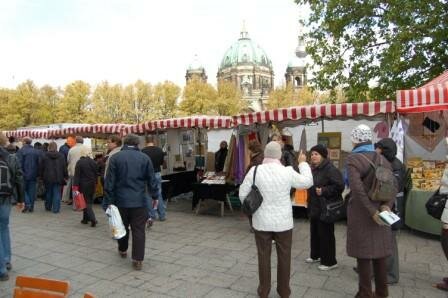
A street market off the Unter den Linden, the Pergamonmuseum can be seen in the background
Euro coins on sale from one of the market stalls |
Early in the month my wife and I took a short break in Berlin. It allowed me to re-visit the Gemäldegalerie, a superb, fine art gallery housed in what must be one of the most user friendly modern buildings in the art world. Certainly compared with the other big boys of world art galleries such as Florence's Uffizi, London's National and New York's Metropolitan it is so much easier to find your way about. I had hoped to reproduce a detail from Rembrandt's wonderful painting "The Gold Changer". All those involved with coins would be able to see a little of themselves in it. Unfortunately the Gemäldegalerie charges to use a photograph of the painting were too high for this free newsletter. Instead I have illustrated these paragraphs with two photographs of euro coins being offered for sale in a Berlin street market. We were also able to visit the Pergamonmuseum on Museum Island. This had a small cabinet of Greek coins in top quality condition. Unfortunately the twenty to thirty coins were not well labelled. I am short sighted but also need reading glasses for close work. The distance between the glass of the display cabinet and the objects made viewing the smaller details on the coins almost impossible for me. This and an officious attendant feeling the need to reprimand me for having my camera bag slung behind me rather than in front almost spoiled what should have been an enjoyable visit to this impressive museum of antiquities. |

November 2008
|
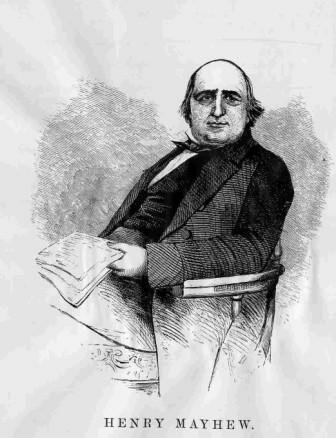
A daguerreotype of Henry Mayhew by Beard |
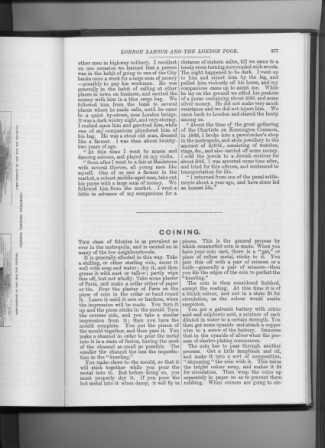
The start of the entry on coining in Mayhew's London Labour and the London Poor, volume four |
|||
|
I spent some time this month trying to find a copy of the entry on coining in Henry Mayhew's "London Labour and the London Poor". I had read this entry many years ago but could not remember any details of the content. This ground breaking work was published in 1861-1862. It contains what has been described, "as the greatest sociological study in English" [John D. Rosenberg, Professor of English, Columbia University]. It is in essence the first oral history. Mayhew interviewed representatives of all the various occupations carried out on Victorian London's streets. These occupations include costermongers, the Hindu tract seller, the baked potato man and many, many more. He attempted to back this up with whatever statistics he could accumulate. It is a fascinating book that makes very real what appear to be the unlikely characters in some of Dickens' books. My search first took me to Google books but although this contained what appeared to be a full copy of Mayhew there was no mention of coining. I next visited my local bookshop but could only find a modern abridged version of the book with again no mention of coining. However this book allowed me establish that there was a fourth volume of "London Labour" with the the sub-title of "Those that will not work, comprising prostitutes, thieves, swindlers and beggars, by several contributors". I found a full set of a 1980's reprint of the four volumes for sale on the web for £250. This was too expensive for me. Eventually I was able to find copies of all four volumes of the work at my local, university library. Coining was covered in three pages and was written not by Mayhew but one of his assistants, John Binny. Part of this entry consisted of a quite detailed description of producing cast, counterfeit coins. The remainder of the entry consist of telling of the exploits of a Mr. Brennan and his often violent capture of various coiners. Unfortunately this section does not include an interview with a coiner or any illustrations. |
||||
December 2008
|
I had a busy month with much happening and being published on counterfeit coins. However one of my highlights was finding a of the English translation of, "An Essay on the Means of Distinguishing Antique from counterfeit Coins and Medals" by M. Beauvais on Google Books. This was originally published in French in 1739. A later improved version was translated into English by G. Beauvais and J.T. Brockett and published in 1818. To my knowledge this was the first book published that was wholly devoted to counterfeit coins. I have only dipped into it at present but this excerpt wets my appetite: "It was never, however, more necessary to furnish the admirers of medals with the requist means of defending themselves against the different artifices of forgers, than at this time, when France and many other countries are inundated with such a prodigious number of false medals;- brought and continually bringing from Italy." Nothing seems to change. |
||
|
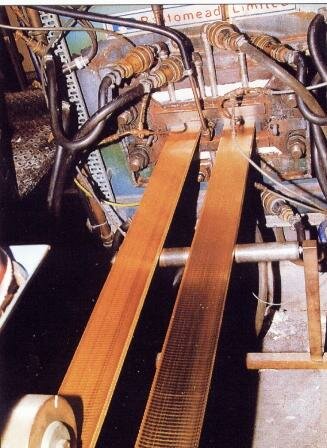
This photograph shows the twin slab continuous caster that was used in the Royal Mint's Precious Metal Unit [PMU] |
27 December, I learnt today that the Royal Mint had closed down its Precious Metal Unit, PMU. It seems this unit was closed about eighteen months ago. This unit was responsible for the melting, rolling and blanking of gold and silver alloys in the mint. The striking of the designs onto the blanks takes place in the separate, Proof Coin Unit. Apart from a period during the move to Llantrisant the Royal Mint has had a facility for making these blanks for the last thousand years. For those interested in how proof gold coins were produced at this Precious Metal Unit see an article I wrote for the 2002 "". I spent thirty years involved with this unit and its predecessors and this decision really saddens me. I could not understand how I could have missed the announcement from the Royal Mint about this. On further investigation I find I did not because the Royal Mint did its best to keep this hidden. The only references to the closure I can find are two obscure notes to the accounts in the 2006-2007 and 2007-2008 Royal Mint Annual Reports. There hidden in "Exceptional Items" are entries labelled "Costs associated with the closure of the Precious Metal Unit". No mention of this closure is made in the report of the year's performance. More surprising again is that there was no mention of this closure when the outgoing, temporary, chief executive, David Barrass, and his successor, Andrew Stafford, appeared before the House of Commons' Treasury sub-Committee on 10th October 2007. This sub-committee totally failed to explore where the cost savings being generated by Mr. Barrass originated. These British members of Parliament totally failed the public interest. It seems the Royal Mint did not want its owners, the British public, or its customers to know that it no longer produced its own precious metal coinage blanks. So there has been no public attempt to justify closing what was the United Kingdom's last significant precious metal blank producing facility. There may be a good case for this decision but the Royal Mint's board, with only one or two members in nine with any background in coining, have not been prepared to make it in public. It must be assumed this is part of the frantic effort by the Treasury and the Mint board to produce a good looking balance sheet before privatisation. The fact that the country has lost a strategic facility does not seem to matter. It is rather ironic to find that the Mint's gold blanks are now being provided, not by a country with low-cost labour but by an American company. I suppose the next logical step would be to take the cheaper option of sending the coinage dies to this company in the USA to strike the coins as well. British sovereigns made in the USA do you think they should sell well? |
|
Return to Contents.
Examples of Counterfeit USA Dollar Coins
Readers from the USA and Wider may be interested in visiting this page on the SmallDollar.com website. It contains photographs of two examples of counterfeit Anthony and Sacagawea dollars. Do not forget to return to this page to finish reading this newsletter.
"Examination of some counterfeit Indian 5-rupee denomination coins: a case study." Subrata Deb, Sudip Debnath and H. K. Pratihari, The Indian Police Journal, Vol. LV, No. 1, pp. 32-37, January - March 2008. [see on web at this ]
This paper records the results of an examination by the Indian State Science Laboratory, Tripura, of twenty-two, incomplete, counterfeit 5-rupee coins and associated counterfeiter's equipment. These counterfeits appear to be cast copies produced using a metallic "dias". Dias is not a term familiar to the editor but it is assumed it is a coinage mould. Unfortunately the paper does not speculate as to the technique used to produce this metallic "dias". Another interesting piece of equipment appears to have been used by the counterfeiter to squeeze a milled edge on the counterfeit after casting. The paper is well illustrated but unfortunately the focus of the photographs on the online version is very poor.
The paper includes a table of results of the physical measurements and the composition found of the counterfeits. It quotes the composition found using SEM-EDX as being 61.72% lead and 30.07% antimony. No indication is given as to the measures taken to ensure that the SEM-EDX analysis was representative of the bulk analysis. A mean specific gravity of 4.4 is quoted for the counterfeits. A 62% lead, 30% antimony alloy would normally be expected to have a specific gravity in the range about nine to ten gramme per cubic centimetre depending on the composition of the remainder of the alloy. Casting defects could easily account for this disparity of results but they should have made the production of a mean specific gravity meaningless in the first place.
A paper such as this describing work on counterfeit coins in a modern, forensic laboratory is rare and as such is very much to be welcomed. It is unfortunate that the scientific content of this paper is, to be brutally frank, rather second rate.
Counterfeit Coins of England and the United Kingdom
The Bibliography and individual counterfeits' record
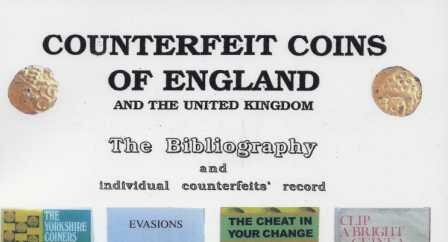
"Counterfeit coins of England and the United Kingdom" by Ken Peters, published by Envoy Publicity, Kent, 2008.
Soft covers; 176 pages; illustrated throughout the text with black and white photographs of counterfeit coins from the author's collection plus four pages of colour photographs on high gloss paper; price £25.
The author, who is the president of the Counterfeit Coin Club, explains in a note "This is the first-ever Bibliography to be published on any area or aspect of counterfeit coins. To be first is to set oneself up for target practice." This reviewer will not indulge in such target practice but warmly welcomes this venture. The bibliography attempts to list articles on counterfeiting in the British Isle from Celtic times to the present. It also includes any descriptions published on individual counterfeits.
As well as printed material sources the bibliography includes sources from the Internet and even video productions. At this point the reviewer needs to declare an interest as this newletter is cited on a number occasions. The printed sources mainly rely on articles in numismatic and archaeological publications but some sources in magazines and the press are listed for the nineteenth and twentieth century. As a retired scientist the reviewer was disappointed so few sources from the scientific journals are cited. However it is to be expected with such a first attempt readers will find gaps and omissions in the listings. The author writes, "I am sure that with assistance, a useful Supplement will evolve in no time at all!" This is all that can be asked from such a venture.
This is not a book meant for reading from cover to cover, it is meant for reference or research. The reviewer has already found it useful in listing the edition of "The Strand Magazine" that covers "coining" in the 1890s. The details of this reference had been sought for some time.
"A Lead Impression of a French Coin from Somerset". Richard Kelleher, Spink's Numismatic Circular, December 2008,CXVI No. 6, pp. 297-298
This short note describes a lead sheet found in April 2008 by metal detector enthusiast George Stevens in Ashill, Somerset. The sheet is 76mm x 68mm x 5mm thick and contains an impression of the reverse of a silver quart d'ecu of Henri III, king of France (1574-89). Richard Kelleher says, "the exact purpose of the sheet is unclear but it is likely the remnant of some form of illicit forging activity." He theorises that an original coin was pressed into the sheet to form the impression. A similar sheet containing an obverse impression was then made. A counterfeit was them produced by inserting a base-metal core covered by two silver foils between the two lead sheets and pressing them together. The note cites evidence that this French coin was circulating in England at this time.
This intriging piece has been donated by Mr. Stevens to the Somerset County Museum.
Other recent literature viewed:
"Prevalence and Profitability: The Counterfeit Coins of Archaic and Classical Greece" Robert Conn IV, MA Thesis, Florida State University, 2007 [This 98 page pdf document is on the web at ]
"Study of ancient Islamic gilded pieces combining PIXE-RBS on external microprobe with sem images" M. D. Ynsa and nine others, Applied Physics A, 92, pp. 235-241 (2008). One of the pieces examined is a mercury-gilded, counterfeit coin from the period of Abderraman III [10th century AD]. This paper contains very little numismatic information.
"A new hoard of denarii imitations" Phillip Davis, on-line at . This paper is a study of a group of Dacian, Roman Republican imitations found in a hoard supposedly from Rumania that surfaced in the coin trade with no provenance. As Phillip Davis recounts because of the coins' provenance this study has been rejected by some scholars as "of no scientific value". Readers can judge for themselves.